
Dangerous Places for Cats


Home is where the cat is. And in a home with a feline occupant, the cat is everywhere, including in nooks and crannies that the human residents may not have even known existed. Thus, you need to make sure that your multi-species domicile is safe for your kitty, so she can play, primp, and purr in peace—and you can have peace of mind.
This article focuses on many, though not all, common locations in homes that are likely to pose risks to cats. By being aware of these danger spots and knowing how to make them safer and/or prevent your cat’s access to them, you can help keep your feline companion healthy and happy in her indoor territory.

Fireplace: A Dangerous Spot for Cats
A cat reposing by the fireplace is a classic and relaxing scene. Keep it that way by always having a sturdy screen around the fireplace. Never leave kittens unsupervised in a room where there is a fire going. Cats can be injured or even start fires: "Fire Safety for Cats."
Beware of the Stove if You Have a Cat
Do not leave the stove unattended when in it's use. Cats can often not avoid the temptation of jumping up to see what's cooking, and severe paw pad burns can be the result. Your cat can also start a fire by walking through the flames or hitting the knobs on the stove. Consider placing knob protectors on the stove. Learn more here: "Fire Safety for Cats."
Kitchen Counters Hold Dangers for Cats
To a cat, the kitchen counter beckons. It’s elevated, it may have interesting foods available for sampling, it’s often near a window, and a favorite human may be stationed there. But kitchen counters may also be fraught with dangers: many foods that are fine for humans are harmful to cats, there may be knives on the counter, the counter may be adjacent to the stove—and you don’t want your cat to get into the habit of venturing over to the stove area, even if it is off.
For feline and human-approved solutions to keeping cats off kitchen counters, see “How to Keep Your Cat off the Kitchen Counter."
Refrigerators Can Be Dangerous to Cats
Do a quick scan of the refrigerator before closing the door, especially if your cat has been known to jump inside to investigate. Note that kittens may be harder to spot because of their small size and more likely to check out the refrigerator contents due to their hyper-curiosity. A cat caught inside a closed refrigerator could be in danger.
Ironing Board: Unsafe for Cats
An iron on ironing board in a house with a cat is an accident waiting to happen. Ironing boards are notoriously unsteady; all it takes is a small jostle for the iron to fall off and hit your kitty. Store irons in a secure spot, not on the ironing board, when they are not in use. Never leave hot irons unattended.
Cabinets Could Be Danger Spots for Cats
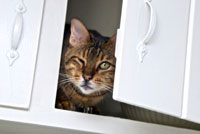 Cabinets can be dangerous for cats mainly for two reasons: what’s stored in them and the potential to be trapped in them.
On the second point, after you’ve had a cabinet open, check to make sure you know where your kitty is. You’d be surprised—or maybe not—at how quickly and quietly a cat can sneak into an open cabinet. This is doubly true for kittens and small cats.
If you have anything in a cabinet that might be hazardous for cats, such as liquids and sprays used for cleaning, or that you don’t particularly want to be covered with cat fur, such as pots and pans, shut cabinet doors as soon as you’re done using the cabinet. For extra safety, use child-proof locks. Is it OK for your kitty to have a quick investigative snoop of the cookware cabinet? Well, we won’t tell if you don’t.
Closets Can Threaten Cats
As with cabinets, closets pose two main dangers: the contents of the closet and the ease with which one can close the closet door with a kitty still inside. When bringing home dry-cleaning, dispose of the clear plastic around the clothes before hanging them in the closet. Mothballs can be highly toxic; safer alternatives include cedar blocks (sand regularly to maintain effectiveness), lavender sachets, dry cleaning, running items through a hot drier, and storing garments in airtight plastic containers during the off-season. Also note that, unlike wool, acrylic is essentially moth-proof.
Children’s Rooms Can Hold Feline Hazards
If you have young children, endeavor to buy toys that are both cat-safe and baby or toddler-safe: no small removable parts, no strings that are detachable or easy to break off, and so forth. Be scrupulous about putting toys away, and teach your children to do the same, for everyone’s safety.
Home Offices: Dangers Lurk for Cats
If your cat has a tendency to chew wires, cover them to safeguard against your cat being shocked. You can buy conduits made for this purpose in most home supply stores and many electronics stores. Always unplug the paper shredder when not using it.
Garage and Utility or Laundry Room: Cat-Free Zones
These rooms usually contain toxic substances and should be off-limits to your kitty, with the possible exception of short excursions that are carefully chaperoned by a responsible human. Promptly clean up all spills. If the washer and drier are in the utility room, always shut the door, after you’ve validated that kitty is out of the room, when using either of those two appliances. Also be aware of the dangers of detergent pods for cats.
Clothes Dryer: Super Dangerous for Cats
A dryer with warm clothes and an open door may be an inviting place for a cat. Unfortunately, it’s all too easy for someone to casually shut the door and not see that there’s a kitty inside. Make it a strict habit to never leave the dryer door open. In addition, before starting the dryer, always make sure that no animals have crawled in while you weren’t looking.
Washer: Also Dangerous to Cats
Though cats generally eschew water, they like to bundle up in piles of clothes. Ensure that there are no stowaway kittens in your clothes when you put them in the washing machine. Don’t rely on a quick visual inspection, either. Feel around before starting the washer or dryer.
Bathrooms Hold Hidden Feline Dangers
The age-old debate has been settled if you have a kitten: keep the lid to the toilet down. Kittens can fall in the toilet. You may as well be safe and keep the lid down regardless of the age of your cat.
All medicines and cleaning formulas must be safe from the dexterous paws, claws, and teeth of a curious kitty.
Balconies Are Hazardous to Cats
Cats fall off balconies and out of upper floor windows so frequently that the condition is called “high-rise syndrome” by emergency veterinarians. Cats should not be allowed on balconies. It can happen so quickly: a cat gets caught up in the moment and leaps after a bird or squirrel. Railings offer little protection; cats can fall through them, slip under them, or jump on top of them and lose their footing.
Close the door leading to the balcony at all times when not using it. Do not put your cat’s scratching posts, food bowl, or bed near the balcony, and do not play or have fun times with your cat near the balcony—do not give your cat positive associations with the balcony area or any reason to hang out near it.
And no, cats do not always land on their feet, and even when they do, the impact from a long fall can be crippling or fatal.
Windows Are Danger Spots for Cats
All windows should have sturdy screens. Patch or repair window screens that have holes right away. A few well-placed scratches and your kitty could make the hole wide enough to fit herself through. Her silent escape could occur in the middle of the night and it might be a long time before you even figure out what happened. You may also want to replace flimsy screens on your kitty’s favorite windows with heavier models.
Curtains and blinds can be extremely dangerous if they have looped cords. Cats, especially kittens, can hang themselves on the loop at the end of the cord. Cut all looped cords or replace them with cords that do not have looped handles.
Do a “Cat’s Perspective” Audit of Your Home Routinely
To get an idea of all the places in your home that your cat may discover, first get down on your hands and knees and look around each room. You may be surprised at all the tight spaces and passageways available for investigation by a curious kitty. Determine whether each of these locations is safe for a cat, and if not, seal them off or modify them so that they don’t pose a hazard. Then do the same thing while standing up and searching for all the places, including high-up coves and shelves, that a cat can reach through jumping.
Repeat this process periodically to ensure no new hazards have appeared.
Do Frequent “Kitty Checks”
It’s ten o’clock—do you know where your cats are? If you haven’t seen your kitty in a while, make sure she’s OK. If you’ve just been opening and closing doors to closets, cabinets, the dryer, the washing machine, out-of-bounds rooms, or the not-always-so-great outdoors, that’s an ideal time to do a kitty check and affirm that all feline family members are safe and accounted for. Other opportune times to do a kitty roll call are when you’ve been particularly busy or when you have guests who may not know all the cat-related rules of the house (even after you’ve told them) or who may have cat-unsafe habits such as holding the front door open.

“Do This, Not That.”
A general cat-friendly way to redirect your cat toward safe alternatives when she is headed toward a danger zone is to do this two-step approach:
- First, dissuade your kitty from going to the verboten area by clapping your hands and saying “No!” in your startling-but-not-frightening “bad kitty” voice.
- Then, offer your kitty a human and feline-acceptable alternative. For instance, if she is approaching the dryer, after getting her attention and telling her she can’t go there, offer her a recently-worn shirt on which to lie, move a favorite bed to a sunny spot, or see if she wants chase a catnip toy.
In this way, your kitty doesn’t get frustrated and harbor pent-up energy, which can result in aggressive release mechanisms. Instead, she learns that there is always a Plan B that meets with her and your approval.
Extra Risk Factors for Kittens
Because of their small size and frequent explorations, kittens have a higher potential for getting into perilous situations. Be extra-vigilant and precautionary with kittens; there is an added level of urgency in “cat-proofing” your home when you share it with kittens.


You May Also Like These Articles:
The Dangers of Detergent Pods for Cats
Foods Toxic to Cats - Slideshow
Top 10 Cat Toxins of 2016 - Slideshow
Stop Doing These Things to Your Cat Right Now
Notice: Ask-a-Vet is an affiliated service for those who wish to speak with a veterinary professional about their pet's specific condition. Initially, a bot will ask questions to determine the general nature of your concern. Then, you will be transferred to a human. There is a charge for the service if you choose to connect to a veterinarian. Ask-a-Vet is not manned by the staff or owners of CatHealth.com, and the advice given should not delay or replace a visit to your veterinarian.
 Facebook
 Twitter