
Cat Spraying: Feline Marking Behavior

One of the biggest concerns that people have with cats is urination outside of the litter box. This problem afflicts about 10% of indoor cats at some point in their lifetime. There are many possible reasons for this frustrating behavior. When dealing with urine outside of the box, it's important to first determine whether you are dealing with inappropriate urination or urine marking. Though some causes and treatments for the two conditions overlap, it does help to know which your cat is exhibiting to formulate the best plan.
If your cat is urinating or spraying outside of the litter box, visit your veterinarian first to rule out a medical condition.
Inappropriate Urination versus Urine Marking in Cats
Some of the ways you can start to determine whether your cat is marking territory or has a problem with the litter box are:
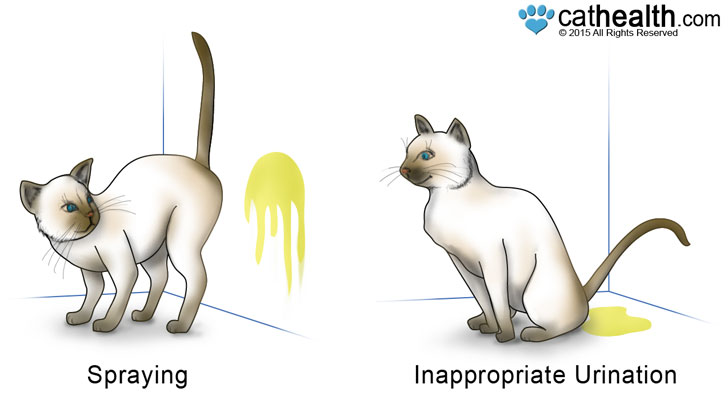
- Most of the time, though not always, cats mark with urine by backing up to a vertical surface and depositing the urine onto it, rather than squatting down and urinating on a horizontal surface. This is also called spraying. If you were to be watching when this happened, you would see your cat back up to a surface, stand with his tail straight up in the air, and spray urine while twitching his tail and sometimes his hind legs. Common areas that are sprayed by cats are walls, furniture, and door frames.
- When cats are marking, they also use the litter box for urine, in contrast to inappropriate urination, where they are often not urinating in the box at all.
- Cats void less urine when they are marking than when they are urinating.
- Urine used for marking smells stronger than regular urine because it contains extra chemicals for transmitting information.
So My Cat Is Marking: Why?
Cats use olfactory cues (leaving and "reading" odors) as a major form of communication. Their sense of smell is far more developed than that of humans (about a thousand times more sensitive). Cats also use the Flehmen response to smell things better. This is a special position of the mouth that a cat assumes when smelling pheromones (hormonal markers left by other cats). It allows the sniffed-in air to flow over a cat's vomeronasal organ, located in the nasal cavity, so they can get the information they need form it. You can see a cat using the Flehmen response to smell something better in this video.
So cats mark because they are communicating something. The most common triggers going on in a household where a cat or cats are marking are:
- The cat is not neutered. Un-neutered males and females in heat will often urine mark as part of their natural behavior, to let other cats know their reproductive status. This is one of the reasons that it is extremely important to neuter all cats not specifically meant for breeding purposes.
- There is stress in the home. Cats may react to stress by marking their territory to feel more secure. If you begin finding urine outside the litter box, suspect a marking behavior if there has been any change in your kitty's social environment such as the addition of a new pet into the household. A new baby or another person who detracts attention from your cat may also trigger this behavior because cats often urine mark when they are insecure about their environment.
- There is a disagreement among the cats. Cats in the wild are lone hunters. They don't gather together into groups often. When cats live together in households, they need to have their own space; a way to avoid and retreat from the other cats when they want to. Because of this, separating indoor cats can be extremely helpful in controlling marking. Provide each cat with a separate room containing plenty of toys, food, scratching posts, and an appropriate litter box. The cats may be allowed out together only when they are 100% supervised. An excellent bonding behavior between cats is grooming each other. Occasionally, if cats are grooming themselves in close proximity to one another, they will begin to groom each other. To facilitate the desire to groom, you can try wiping them down with a damp cloth when they are together. This will cause them to groom themselves, and they may even begin to groom each other.
- Outdoor cats are causing frustration. Cats may also spray if they can see other cats in the neighborhood. They may spray on the window or by a door. To deal with this problem, try to block the cat's view of the intruder. A border along the bottom of the window is often effective. Also, remove any bird feeders or other attractants which may bring outdoor cats to your property. You may also need to close blinds or doors in your home so your cat can't see the outdoor cat.

General Tips to Stop Cat Urine Marking
Regardless of the cause of the marking, it's important to thoroughly clean all soiled areas using an enzymatic stain remover. This helps reduce the instances of the cats marking overtop of their housemates' marks or attempting to freshen their own.
Feliway is a product which you spray in the environment. It is a feline facial pheromone analogue and helps to impart a good feeling to the cat. It needs to be sprayed twice daily around prominent areas of the house at your cat's nose level. It can be very effective at reducing spraying.
In certain situations, medications may be necessary to reduce your cat's anxiety and stop the marking behavior. Talk with your veterinarian to determine whether this might be a good option for your cat. There are several choices, and these drugs can be used to calm the feline situation in your home while you institute cleaning and behavior modification measures.
You may need to consult with a feline behavior specialist to help you determine what's going on with your cat and how you can help.
For more information on inappropriate urination, view our Cat Not Using Litter Box? Inappropriate Urination in Cats article.


You May Also Like These Articles:
How to Detect and Clean Urine Stains
Inappropriate Urination in Cats
Tips for Good Litter Box Placement
Tips for Avoiding Litter Aversion in Cats
Earth Day: How to Green-Up Your Cat-Care Routine
Tips for Good Litter Box Cleaning
Feliway - A Useful Tool to Help Treat Stress in Cats
Notice: Ask-a-Vet is an affiliated service for those who wish to speak with a veterinary professional about their pet's specific condition. Initially, a bot will ask questions to determine the general nature of your concern. Then, you will be transferred to a human. There is a charge for the service if you choose to connect to a veterinarian. Ask-a-Vet is not manned by the staff or owners of CatHealth.com, and the advice given should not delay or replace a visit to your veterinarian.
 Facebook
 Twitter